
What is Huichol Art?
28/11/2024
Huichol Art
An ancient tradition nourished by religious devotion, Huichol art boasts an enigmatic and colorful beauty, which brings us closer to its most remote origins. Huichol Art is a grouping of traditional and current styles in popular and folkloric arts. Fundamentally, Huichol art is a transcription of the images visualized by shamans; caused by the ritual drink "hikuri", from which a number of legends related to its cosmogony arose.
One of the main characteristics of these works is their striking and colorful decoration, sketches that were created several centuries ago. and are the visions they obtain in their rituals. In addition, this style of art can be seen in various objects and paintings that are decorated with beads or small beads and thread, among other things.
Today the materials used in this type of art have been changing, there are also different designs that have been transformed little by little, although there are some symbols that are still taken into account for their important meaning in their communities, beliefs and traditions.

Pilgrimage - Guarding the land and tradition:
The Huichol have been living for many centuries in the states of Nayarit and Jalisco in west-central Mexico where they are now settled. According to archaeologist Dr. Phil Weigand, they and their linguistic neighbors, the Coras, had already established their roots in this area by the beginning of the Classic Mesoamerican season (200 to 700 AD).
The Huichols consider themselves descendants of the black dog, tsuku mauyusauye, who helped them during the flood. The Huichol, also known as Wixárika, live in the Sierra Madre Occidental where the states of Zacatecas, Durango, Jalisco and Nayarit converge. It is in these last two where most of the Huichols live. The places where they are most concentrated are: Mezquitic and Bolaños (northern Jalisco) and in Yesca and Nayar (Nayarit).
The origin of the Huichols is not yet clarified. Historians believe that they come from various groups that settled over the years in the Sierra Madre Occidental. The strongest hypotheses indicate that they come from the Aztec juto branch and that they were displaced by some Mesoamerican empire. Some investigations indicate that the Teochichimecas would have been part of the Huichols. In their mythology, you can find elements from northern tribes (Teochichimecas) such as the peyote ritual; and elements of southern tribes this is seen in their belief that the gods emerged from the sea.
In the Huichol mythological corpus it explains the origin of a structured existence. The sea, chaos and disorder are apparently pre-existent.
It is possible to consider the Huichol art as a form of writing, since through their creations, the Huicholes tell us their stories and myths, leaving a piece of their life in each work they make. Currently, it can be said that there is no other ethnic group in Mexico that preserves their beliefs, cults and traditions as deeply as the Huicholes.
Who are the Wixarikas?
We can say that the Huicholes are and were indigenous, the great part of them used to inhabit mountainous places, these places were in the north of Jalisco and a great part of Nayarit, the center of Mexico. Today it is considered that there are 50,000 in those areas. The Huicholes are one of the ethnic groups that have managed to remain "pure" since the time of the Spanish conquest. The origin of Huichol art lies in an ancestral tradition, where the physical transcription of the images visualized by the Huichol shamans is passed from one generation to another.
When the Spanish invaded the territories, the Huichol people fled to the mountains, difficult to access, to preserve their autonomy. This independence allowed them to forge a culture with traditions and a very particular aesthetic. His yarn paintings, beads, bags, clothing items and more have been widely accepted both in the Mexican market and abroad. However, this town does not have many places to sell their creations, and the intermediaries who buy their work to resell it, sometimes earn much more than the producers themselves.
The Huichol religion is based on beliefs, ceremonies and myths as well as a trinity.The ritual is based on the veneration of peyote, deer and corn. These things have a great importance apart from the representations of the gods that make them stylistically.
Huichol art has its beginnings in ritual art: belongs to a specific religious practice of an indigenous group, making Huichol art have different dimensions than the contemporary art we usually find in museums and galleries.
The Huichol world is divided into three universes: that of mythology, maintaining that life began in the ocean; the one referring to the corn, where daily life and Huichol traditions are developed and the one that has to do with the mysticism, which reveals the Huichol world and the Huichol art of their rituals that distinguish them and give them identity as a Huichol community.
Types of Huichol art expression
Thus, the religious philosophy of the Wixaritari is based on a universe divided by three entities: the deer, the corn and the peyote. This tradition, transmitted for centuries, in oral and practical form, has as a common quality, the use of the yarn to capture diverse symbols with colorful tonalities, in this way, they are used to decorate the weaving of paintings, masks, and clothing, such as belts, belts or bags; and even, they are engraved in bowls and musical instruments. Additionally, when the Huicholes elaborate their ceremonial articles, they give much importance to the materials, colors and designs used, due to their sacred meaning related to the gods, for example, the wood of the Brazil tree is linked to Tayau or father sun, and the white flower of five petals is associated to the rains, good harvests and health. However, the most important motifs in the art of the Huichol culture are associated with deer and corn, as the primary source of food, and with peyote, as the link to the cosmogonic dimension.

A type of artistic expression of the Huichol art are the worsted squareswhich are made on wooden boards with wax, or the pieces that are worked by lining figures with chaquira on bules, deer, violins, turtles, etcetera. One expression is the works that are made with beads or thread (yarn), each one carries symbolic motifs, stories of the Huichol culture and Huichol legends of their cosmogony that offer us an overview of Huichol society.
The production and decoration of works of art with beads or beads did not begin with the entry of glass beads from Europe, which was what happened with thousands of indigenous cultures, but rather these beads have been used for centuries in the Huichol culture in which stones, turquoise, clay, bones, jades, seeds, etc. were used.among other things. This art gradually became popular thanks to the thread paintings. However, the designs that these paintings represented were difficult to imitate and many of the Huichol artists took weeks to finish a single design.
Although nowadays, in Huichol art many of the traditional materials, such as clay or vegetable dyes, have been replaced by others of industrial elaboration, the ancient ancestral techniques are still in force, in this sense, among the numerous artistic manifestations, the beads to decorate necklaces, masks or fabrics, made of coral, turquoise, pyrite, jade, and even sometimes, with seeds, stand out. On the other hand, there are the nierikas, which were initially elaborated by shamans to reproduce their supernatural visions, in a small wax disc with a hole or mirror in its center, wrapped and pressed by colored threads, which finally served as an offering for the deities. In this respect, as a derivation of the nierikas, there are the well-known worsted paintings, being made with the same method, they conform a contemporary expression very similar to paintings, but spun with great perfection and beauty. To conclude, Huichol art is a form of writing that tells the stories and myths of a civilization that deeply preserves its beliefs.
Outstanding artists of Huichol art
Among the most famous artists of this style of art we can highlight the following Emetaria Rios Martinez who made a large number of murals simply with worsted squares. We must also highlight José Benítez Sánchez and all his family who was one of the artists that helped the stamens paintings to move to other countries, to name just a few of the most relevant for their technique and style: Sixto Manjarez de la Cruz who is a creator of different works, Kukame Olegario who develops both traditional materials and innovative techniques. Candelario Rios Gonzalez, Justo Benitez - Tayeima, Hilaria Chávez Carrillo, Constanza Diaz V., Evaristo Díaz Benitez, Reynaldo Díaz, Ramón Medina Bautista, Santos Lara, Rogelio Hernandez, Norma Carrillo, Gonzalo Flores, Rogelio Diaz M. There are an infinity of artists and each one has its own characteristic and original style that makes each work an artistic piece of great visual and symbolic quality.
You can see some works and if you want to know all his work we invite you to visit our section Huichol art
-
 SALE
SALESkull with beads – Huichol Art
AMAH23171MXN $ 6,300.00There is 1 in stockSkull lined and decorated with "beads" by artisans...Add to cart -
 SALE
SALEPiggy lined with chaquira
AMAH23138MXN $ 2,500.00There is 1 in stockPiggy covered with multicolored beads and made by...Add to cart -
 SALE
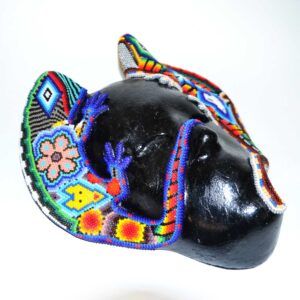
SALEMask - Huichol Art
AMAH24101MXN $ 3,500.00There is 1 in stockHuichol Art - Mask lined with multicolored chaquira and...Add to cart -
 SALE
SALEFrame of beads
AMAH23130MXN $ 1,700.00There is 1 in stockFrame lined with multicolored beads and made by...Add to cart




